

PCR Test: Accurate Detection of Infections and Diseases
 JCI Accredited
 ISO Quality
 International Health Tourism Authorization
 Ministry of Culture and Tourism
 Global Hospital Rating
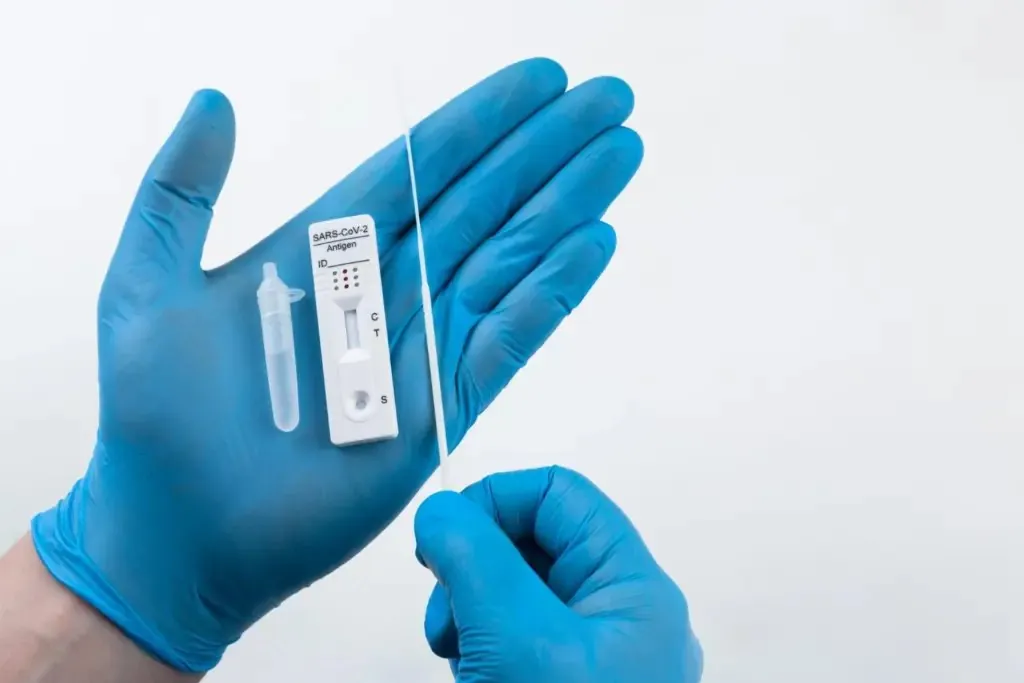
PCR, or Polymerase Chain Reaction, is a laboratory test that works like a molecular photocopier. While microscopes allow doctors to see cells, and X-rays allow them to see bones, PCR allows medical professionals to “see” the genetic code itself. It detects and copies very small amounts of DNA or RNA, the genetic material found in viruses, bacteria and human cells.
PCR helps detect things that are present in very small amounts. In the early stages of an infection or a genetic disease, the pathogen or mutation is often present in such minuscule quantities that standard laboratory tests cannot find it. A patient might have a virus, but if the viral count is too low, a traditional culture test might return a “false negative.” PCR bypasses this limitation by isolating that specific microscopic segment of genetic material and copying it billions of times in a matter of hours. This turns a tiny trace into an amount that can be measured, so many infections and genetic changes can be detected with high accuracy, often at an early stage.
The Working Principle of PCR
The PCR process takes place in a machine called a thermal cycler, which raises and lowers the temperature in precise steps. The process typically involves a cycle of heating and cooling repeated 30 to 40 times.
Step 1: Denaturation (The Unzipping)
The diagnostic process begins with the extraction of genetic material from the patient’s sample (blood, saliva, or tissue).
- Heating: This purified DNA is placed into a test tube and heated to roughly 95°C (203°F).
- Separation: At this high temperature, the double-stranded DNA helix splits apart. The hydrogen bonds holding the two strands together break, resulting in two single strands of DNA. This exposes the genetic information, making it accessible for copying.
Step 2: Annealing (The Targeting)
The temperature is then lowered to between 50°C and 65°C.
- Primers: Short, synthetic strands of DNA called “primers” are introduced. These act like molecular GPS coordinates. They are engineered to match only the specific target sequence the doctor is looking for such as a gene from the Influenza virus or a specific cancer mutation.
- Binding: If the target is present in the patient’s sample, these primers attach (anneal) to the specific landing sites on the single-stranded DNA. If the target is not there, the primers have nothing to hold onto, and no reaction occurs.
Step 3: Extension (The Copying)
The temperature is raised slightly to 72°C, the optimal operating temperature for a specialized enzyme called Taq polymerase.
- Building: This enzyme attaches to the primer and moves down the DNA strand, adding complementary building blocks (nucleotides) to create a new, double-stranded copy of the DNA.
- Exponential Growth: At the end of one cycle, one DNA strand has become two. The cycle repeats. Two become four, four become eight, and so on. Within an hour or two, a few strands turn into millions, creating a sample large enough to be detected by a fluorescent signal or a gel analysis.
Clinical Advantages and Patient Benefits
PCR has largely replaced older, slower diagnostic methods like bacterial culture or serology for many conditions because of its speed and specificity.
High Sensitivity
The main advantage of PCR is its sensitivity: it can detect very small amounts of genetic material.
- Window Period: For infectious diseases like HIV or Hepatitis, traditional antibody tests require the body to produce an immune response, which can take weeks (the “window period”). PCR looks for the virus itself, not the body’s reaction to it. This can allow diagnosis earlier than antibody tests, so treatment can start sooner and the risk of passing the infection on can be reduced.
Speed and “Real-Time” Results
Before PCR, identifying a specific bacterium often required growing it in a petri dish (culturing), which could take days or even weeks for slow-growing organisms like Tuberculosis.
- Same-Day Diagnosis: PCR provides results in hours. In serious infections such as meningitis or sepsis, this speed can help doctors choose the right treatment sooner. Culture tests may still be needed, for example to check which antibiotics will work.
Specificity (Targeted Diagnosis)
PCR is highly specific. It distinguishes between pathogens that look similar but require different treatments.
- Differentiation: For example, it can determine not just that a patient has the Flu, but specifically whether it is Influenza A or Influenza B. In oncology, it differentiates between cancer cells that have a specific mutation (like EGFR in lung cancer) and those that do not, which helps doctors choose a suitable targeted treatment.
Clinical Uses of PCR
PCR is used in many areas of diagnosis and personalized medicine.
Infectious Diseases
- Viral Load Monitoring: It is the standard test for monitoring chronic viral infections such as HIV and Hepatitis C. By measuring how many viral copies are in the blood (Viral Load), doctors can determine if antiviral medications are working.
- Respiratory Panels: A single PCR swab can simultaneously test for multiple respiratory pathogens (COVID-19, RSV, Influenza, Adenovirus), which can help avoid unnecessary antibiotics for viral infections.
Oncology (Precision Medicine)
- Liquid Biopsy: PCR facilitates the detection of “Circulating Tumor DNA” (ctDNA) in a simple blood draw. In some cancers, this can help oncologists monitor treatment response or look for recurrence without a tissue biopsy.
- Genetic Profiling: It identifies specific mutations (such as BRCA1/2 in breast cancer or BRAF in melanoma) that may make patients eligible for targeted cancer treatments.
Clinical Genetics
- Prenatal Screening: Non-Invasive Prenatal Testing (NIPT) uses DNA-based technology to analyze fetal DNA in the mother’s blood and screen for chromosomal conditions such as Down syndrome, without the risks of amniocentesis. It is a screening test, so a high-risk result needs to be confirmed with a diagnostic test.
- Carrier Screening: It identifies parents who carry genes for hereditary conditions like Cystic Fibrosis or Spinal Muscular Atrophy, aiding in family planning.
Contact our team
How can we help you? Share your contact details to prepare your request.
How can we help?
By submitting you confirm you have read the privacy information and consent to the processing of your personal data.
Step-by-Step: The PCR Test
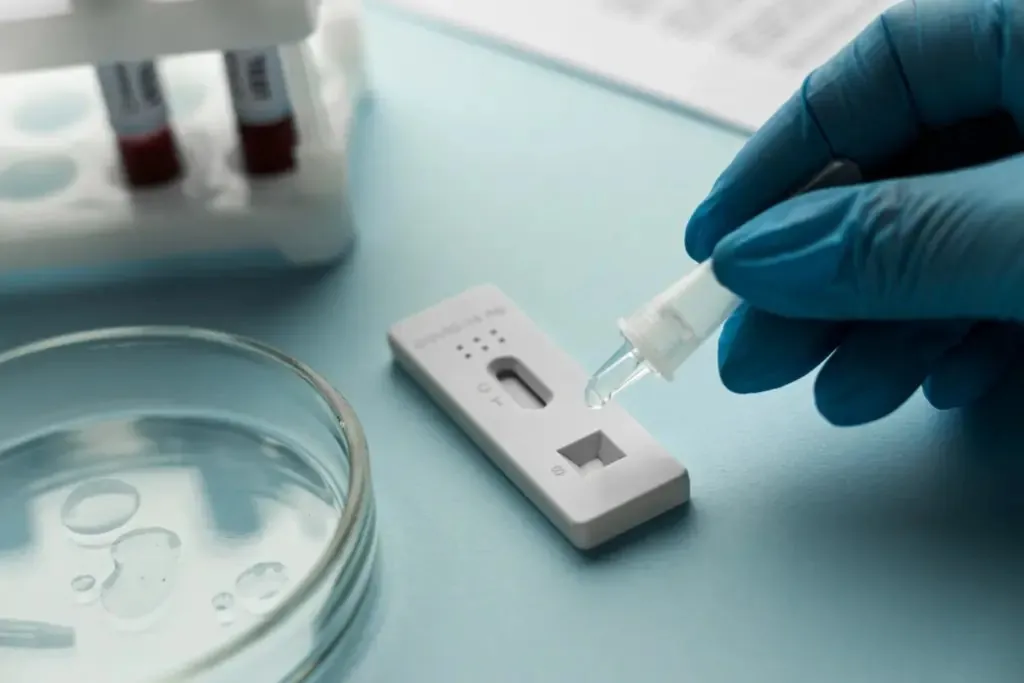
For the patient, a PCR test is defined by the sample collection method, as the actual “reaction” happens entirely in the laboratory.
Sample Collection
The experience depends on what is being tested:
- Respiratory Swabs: For viruses like the flu or COVID-19, a thin, flexible swab is inserted into the nose (nasopharyngeal) or throat. This can cause brief discomfort, often described as a tickle or the sensation of getting water in the nose.
- Blood Draw: For genetic testing, HIV monitoring, or liquid biopsies, a standard venous blood draw from the arm is performed. No fasting is typically required for genetic PCR tests.
- Tissue Sample: In oncology, the PCR is often run on a piece of tissue already removed during a previous biopsy or surgery. The patient does not undergo a separate procedure for the test itself.
The Waiting Period
- Turnaround: While the chemical reaction takes only a few hours, logistical processing means results are typically available within 24 to 48 hours.
- Interpretation: The result is usually binary (Detected/Not Detected) or quantitative (a specific number of copies/mL). Your physician interprets this data to adjust your treatment plan.
Safety and Precision Standards
Because PCR is so sensitive, it is prone to “contamination risk.” Laboratories follow strict standards to make sure the DNA detected comes from the patient’s sample.
Unidirectional Workflow
PCR laboratories are designed with a strict one-way traffic flow to prevent contamination.
- Separation: The area where samples are prepared (DNA extraction) is physically separated from the area where the amplification happens. Technicians never move from the “dirty” (amplified) room back to the “clean” (prep) room without a complete change of clothing and decontamination, which helps prevent amplified DNA from contaminating new samples.
Internal Controls
Every PCR run includes “controls” to verify accuracy.
- Negative Control: A sample known to have no DNA is run alongside patient samples. If this control shows a positive result, it signals contamination, and the entire batch is discarded and re-run.
- Positive Control: A sample known to have the target DNA is run to prove the enzyme is active and the machine is cycling correctly.
Automation
Modern high-throughput PCR systems utilize robotic pipetting arms.
- Human Error Reduction: Robotics handle the microscopic liquid transfers (often measuring in microliters). This reduces the risk of samples being mixed up or the wrong volume being measured.



