

NAVIO Robotic System
 JCI Accredited
 ISO Quality
 International Health Tourism Authorization
 Ministry of Culture and Tourism
 Global Hospital Rating
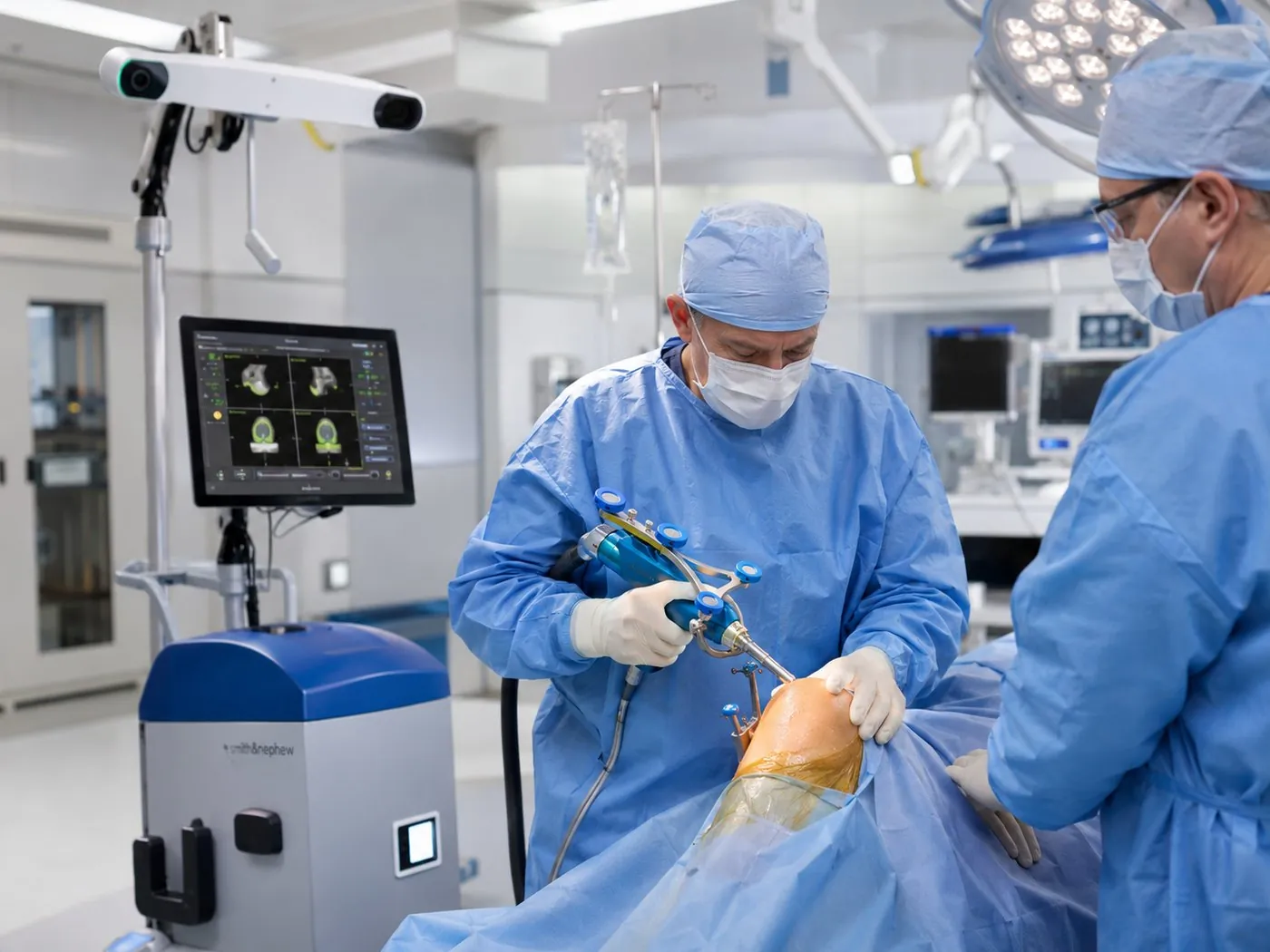
An Introduction to the NAVIO Surgical System
NAVIO is a navigation and handheld robotic system used in knee replacement surgery. It maps the patient’s knee during the operation and helps the surgeon remove bone accurately. A key feature is that it is an image-free technology, requiring no pre-operative Computed Tomography (CT) scans.
Clinical Role of NAVIO
NAVIO is used to help position and align total or partial (unicompartmental) knee implants to match the way the patient’s own knee moves.
- Measurement Accuracy: The system detects angular deviations of less than 1 degree and spatial variances under a millimeter. These small differences are hard to see with the naked eye.
- Restoration of Natural Joint Kinematics: By taking ligament tension into account as well as bone shape, it helps the surgeon balance the joint, with the aim of a knee that feels more natural after surgery.
- No Pre-Operative CT Scan: Because the planning software does not rely on a pre-operative CT scan, the patient avoids the radiation of that scan.
Step-by-Step Clinical Workflow
The entire NAVIO workflow is executed intraoperatively directly at the operating table, utilizing dynamic, live anatomical data:
Phase 1: Intraoperative Digital Mapping
The system captures the patient’s unique joint geometry after the initial surgical exposure.
- Sensor Fixation: The surgeon attaches optical tracking arrays (sensory markers) directly to the patient’s femur and tibia.
- Surface Registration: Utilizing a specialized electronic pointer probe, the surgeon sweeps across the articular cartilage and bone surfaces. The NAVIO software uses these points to build a three-dimensional model of the knee joint on the display monitor.
Phase 2: Dynamic Soft-Tissue Gap Balancing
- Kinematic Evaluation: The surgeon manipulates the knee through a full range of motion (extension to flexion).
- Tension Calculations: The NAVIO software measures the tension and looseness of the collateral ligaments. It then suggests the angle and position of the implant components to help balance the knee in both bending and straightening.
Phase 3: Handheld Robotic Resection (Intelligent Burring)
Once the computer-assisted plan is finalized, the surgeon initiates bone preparation using NAVIO’s specialized handheld robotic instrument.
- Controlled Resection: As the surgeon shapes and removes the bone using the high-speed burr, the tool works only within the planned boundaries.
- Automated Tissue Protection: If the surgeon’s hand inadvertently deviates toward a restricted zone (such as healthy bone stock or critical collateral ligaments), the cutting burr automatically retracts or stops. This helps protect nearby healthy bone, ligaments and soft tissues.
Primary Distinction from the MAKO System
While the MAKO platform operates on a “plan pre-operatively, execute intraoperatively” model (relying heavily on a pre-acquired pre-operative CT scan), the NAVIO system operates on an “intraoperative scan and execute” model utilizing live, real-time kinematic mapping.
Furthermore, NAVIO features a more compact, handheld architecture. Rather than using a large robotic arm, it acts as a digital “seatbelt” and navigation computer, working together with the surgeon’s hand.
Contact our team
How can we help you? Share your contact details to prepare your request.
How can we help?
By submitting you confirm you have read the privacy information and consent to the processing of your personal data.



