

Elastography: Advanced Imaging for Tissue Stiffness
 JCI Accredited
 ISO Quality
 International Health Tourism Authorization
 Ministry of Culture and Tourism
 Global Hospital Rating
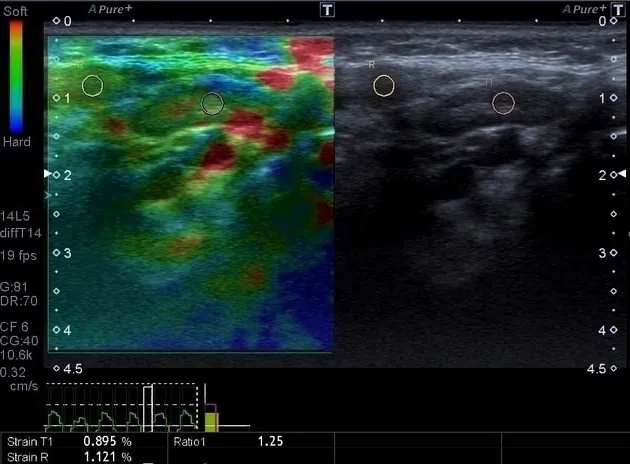
Elastography and Tissue Stiffness
Elastography is an ultrasound-based imaging test used to measure the stiffness or elasticity of tissues. It works like a digital version of a doctor feeling for hard areas or lumps by hand (palpation), but it measures stiffness more objectively. While conventional ultrasound visualizes only the morphology (shape) and structural anatomy of tissues, elastography measures how stiff they are.
The Working Principle of Elastography
Healthy tissues are generally soft and compliant (elastic), whereas malignancies (cancerous cells), fibrosis (scar tissue formation), or inflammatory lesions tend to be stiffer than normal surrounding tissue.
- Acoustic Waves and Compression: The device transmits low-frequency acoustic waves or applies a subtle mechanical compression to the target tissue.
- Velocity Measurement: The propagation velocity of these shear waves through the tissue is measured. Waves travel faster through stiff tissue and slower through soft tissue.
- Color Mapping (Elastogram): The system translates these velocity data points into a color-coded map. The colors used vary between systems; one color shows softer areas and another shows stiffer areas that may need closer attention.
Clinical Applications of Elastography
Elastography is used mainly in three areas, where it can help reduce the need for some biopsies:
1. Liver Assessment (Fibroscan / Shear Wave Elastography)
It quantifies the degree of hepatic stiffness in conditions such as hepatic steatosis (fatty liver), hepatitis, or cirrhosis. In many patients, elastography can now estimate the degree of liver scarring without a liver biopsy (tissue sampling). The test is painless and takes about 5 to 10 minutes. A biopsy may still be needed in some cases.
2. Breast Cancer Diagnosis
It is used together with standard breast ultrasound to help assess whether a breast mass is more likely to be benign (softer) or suspicious (stiffer). This can help avoid some unnecessary biopsies.
3. Thyroid Nodules
By measuring the stiffness index of nodules within the thyroid gland, it can help clinicians decide which nodules meet the criteria for a fine-needle aspiration biopsy (FNAB).
Advantages of Elastography
- Painless and Non-Invasive: It requires no needle insertion or surgical intervention; it is performed solely by placing an ultrasound transducer (probe) on the skin.
- Real-Time Quantitative Results: Tissue stiffness is shown as a number as soon as the measurement is complete, typically measured in Kilopascals (kPa).
- Assessment of Deep Tissues: It can detect stiffness in deep tissues, such as the liver, that cannot be felt by hand.
- Reduction in Biopsies: In some situations, results that point to soft, likely benign tissue can help the patient avoid a biopsy or other invasive procedure.
Contact our team
How can we help you? Share your contact details to prepare your request.
How can we help?
By submitting you confirm you have read the privacy information and consent to the processing of your personal data.



