

Da Vinci Robotic Surgery System
 JCI Accredited
 ISO Quality
 International Health Tourism Authorization
 Ministry of Culture and Tourism
 Global Hospital Rating
The Da Vinci Surgical System is a robotic platform that helps surgeons perform complex operations through small incisions. Although it is called “robotic”, the system does not operate on its own. The surgeon controls it at all times, and the system translates the surgeon’s hand movements into small, precise movements of instruments inside the body.
Open surgery needs a large incision so the surgeon’s hands and instruments can reach the operating area, which can mean more pain and a longer recovery. Conventional laparoscopy (keyhole surgery) uses small incisions, but its straight, rigid instruments have limited movement. The Da Vinci system combines small incisions with wristed instruments that move more like a human hand. This helps surgeons work in tight, hard-to-reach spaces such as the deep pelvis.
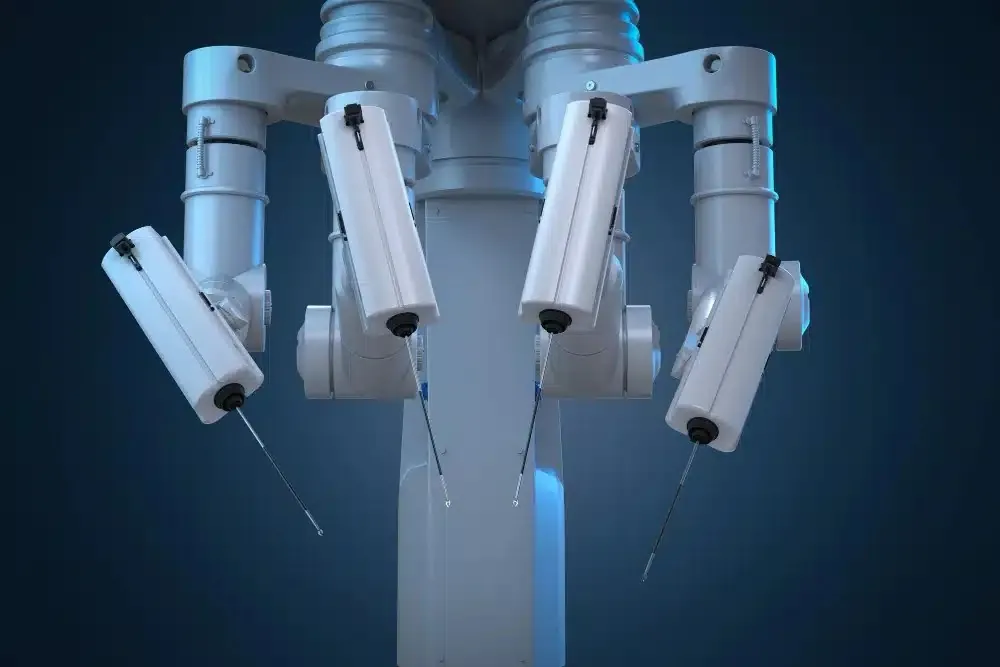
The Working Principle of the Da Vinci System
The Da Vinci system works on a “master-slave” principle: the robotic instruments copy the surgeon’s hand movements in real time. The system consists of three integrated components that communicate via fiber-optic cables.
The Surgeon Console
The surgeon does not stand over the patient. Instead, they sit at a console located in the same operating room.
- 3D High-Definition Vision: The surgeon looks into a stereoscopic viewer that provides a magnified, three-dimensional, high-definition view of the surgical site. Unlike the flat 2D monitors used in standard laparoscopy, this view lets the surgeon judge depth, which is important for separating tissue layers and suturing.
- Master Controls: The surgeon’s fingers grasp master controls below the display. These controls sense the position and motion of the hands and translate them to the robot.
The Patient Cart
This is the robotic component positioned alongside the operating table. It holds the camera and the surgical instruments.
- Robotic Arms: The cart typically features four interactive robotic arms. One arm holds the high-definition camera (endoscope), while the other three hold the specialized surgical instruments. These arms act as the surgeon’s hands inside the patient.
- Pivot Points: The arms rotate around a fixed pivot point (the incision site), which helps limit pressure on the abdominal wall.
EndoWrist Instruments
A key feature of the system is its EndoWrist instruments. Standard laparoscopic tools work a bit like chopsticks: they can open and close but cannot bend. Da Vinci instruments are modeled after the human wrist.
- 7 Degrees of Freedom: These small instruments can bend, rotate and twist with a wider range of motion than the human wrist. They can turn a full 540 degrees, which helps the surgeon reach around blood vessels or nerves and suture from angles that are hard to reach with rigid tools.
Clinical Advantages and Patient Benefits
Compared with open and conventional laparoscopic surgery, robotic-assisted surgery can offer several benefits. How much a patient benefits depends on the operation and their health.
Precision and Control
- Tremor Filtration: Every surgeon’s hands have a natural, very small tremor. The Da Vinci computer system detects these minute, unintentional movements and filters them out electronically. This keeps the instrument tips steady, which is important when working close to nerves.
- Motion Scaling: The system allows for motion scaling. The surgeon can set the ratio so that a 5-centimeter movement of their hand at the console translates to a 1-centimeter movement of the instrument inside the body. This helps with very fine work during delicate reconstruction.
Minimally Invasive Impact
- Reduced Blood Loss: The enhanced 3D vision and precise cauterization capabilities allow surgeons to identify and seal small blood vessels immediately. This can reduce blood loss and the need for blood transfusions.
- Minimal Scarring: Procedures are performed through a few incisions, each less than 1-2 centimeters long. This usually leaves less visible scarring compared to the long scars of open surgery.
- Lower Infection Risk: Smaller incisions mean a smaller pathway for bacteria to enter the body, reducing the rate of surgical site infections.
Accelerated Recovery
- Shorter Hospital Stay: Because there is less trauma to the muscles and tissue, many patients recover faster. After some operations that would need about a week in hospital with open surgery, patients may go home in 1 to 2 days.
- Reduced Pain and Narcotic Use: With no large muscle incisions, post-operative pain is often lower. This can reduce the need for opioid pain medicines and their side effects.
Clinical Uses of the Da Vinci System
The Da Vinci system is used in several specialties, mainly for procedures in areas of the body that are confined or difficult to navigate.
Urology
Urology is one of the fields where robotic surgery is used most widely, particularly for prostate cancer.
- Radical Prostatectomy: Removing the prostate gland requires separating it from delicate nerves that control erectile function and urinary continence. The precision of the Da Vinci arms allows surgeons to “peel” these nerves away from the prostate, to help preserve erectile function and bladder control where possible.
- Partial Nephrectomy: For kidney tumors, the robot allows surgeons to remove only the tumor while stitching the remaining healthy kidney back together, preserving kidney function.
Gynecology
- Hysterectomy: For benign conditions or cancer, robotic surgery allows for the removal of the uterus with minimal blood loss.
- Myomectomy: Removing uterine fibroids while preserving the uterus for future fertility requires intricate suturing. The EndoWrist instruments can make this multi-layer suturing easier than with standard laparoscopic tools.
- Endometriosis Resection: The magnified 3D vision helps surgeons identify and excise deep implants of endometriosis tissue that can be hard to see.
General and Colorectal Surgery
- Colorectal Cancer: Operating deep in the pelvis to remove rectal tumors is challenging due to the narrow space. The robot provides the visibility and reach needed to remove the cancer with clear margins while sparing the anal sphincter, which in some cases helps avoid a permanent colostomy bag.
- Hernia Repair: Complex abdominal wall reconstructions can be performed with the robot to place mesh precisely.
Thoracic and Cardiac Surgery
- Valve Repair: Mitral valve repairs can be performed through tiny incisions between the ribs (thoracoscopy) rather than splitting the breastbone (sternotomy), which can shorten recovery.
Contact our team
How can we help you? Share your contact details to prepare your request.
How can we help?
By submitting you confirm you have read the privacy information and consent to the processing of your personal data.
The Da Vinci Robotic Surgery Procedure
Robotic surgery follows a set sequence of steps.
Pre-Operative Preparation
The preparation is similar to any major surgery. Patients undergo general anesthesia, meaning they are completely asleep and feel no pain. Once asleep, the abdomen is inflated with carbon dioxide gas to create a working space.
The Procedure
- Port Placement: The surgeon makes 4 to 5 small incisions (ports) in the abdomen.
- Docking: The Patient Cart is wheeled to the bedside, and the robotic arms are “docked” (connected) to the ports.
- Operation: The surgeon moves to the console to perform the surgery. An assistant surgeon remains at the bedside to change instruments (e.g., swapping a scissor for a stapler) and assist with tasks like suctioning.
- Completion: Once the procedure is finished, the instruments are withdrawn, and the small incisions are closed with sutures or surgical glue.
Post-Operative Recovery
Most patients are encouraged to walk within hours of surgery to promote circulation. Pain is typically managed with oral medications rather than intravenous narcotics. Return to normal daily activities, such as driving or light work, often occurs within 2 weeks, compared to 6-8 weeks for open surgery.
Safety and Precision Standards
The Da Vinci system has several built-in safety features. Like any surgery, robotic surgery still carries risks such as bleeding, infection or injury to nearby organs, which your surgeon will discuss with you.
The “Dead Man’s Switch” Protocol
The surgeon console is equipped with optical sensors in the viewer. The system will only activate the robotic arms if it detects that the surgeon’s head is properly positioned in the viewer. If the surgeon lifts their head to talk to the team or look away, the robotic arms stop moving. This helps prevent accidental movement of the instruments inside the patient.
Force Feedback (Visual Haptics)
While the current generation of robots does not provide tactile feeling (touch), it compensates with “visual haptics.” The image is clear enough for surgeons to see the tissue blanch (turn white) when gripped, allowing them to gauge the pressure being applied visually. This helps avoid damage from gripping too tightly.
System Check and Redundancy
Before every operation, the system undergoes an automated self-check of its arms, sensors and circuits. During the surgery, the computer performs millions of safety checks per second. If a discrepancy is detected between the surgeon’s hand command and the robot’s movement, the system stops the movement to protect the patient.



